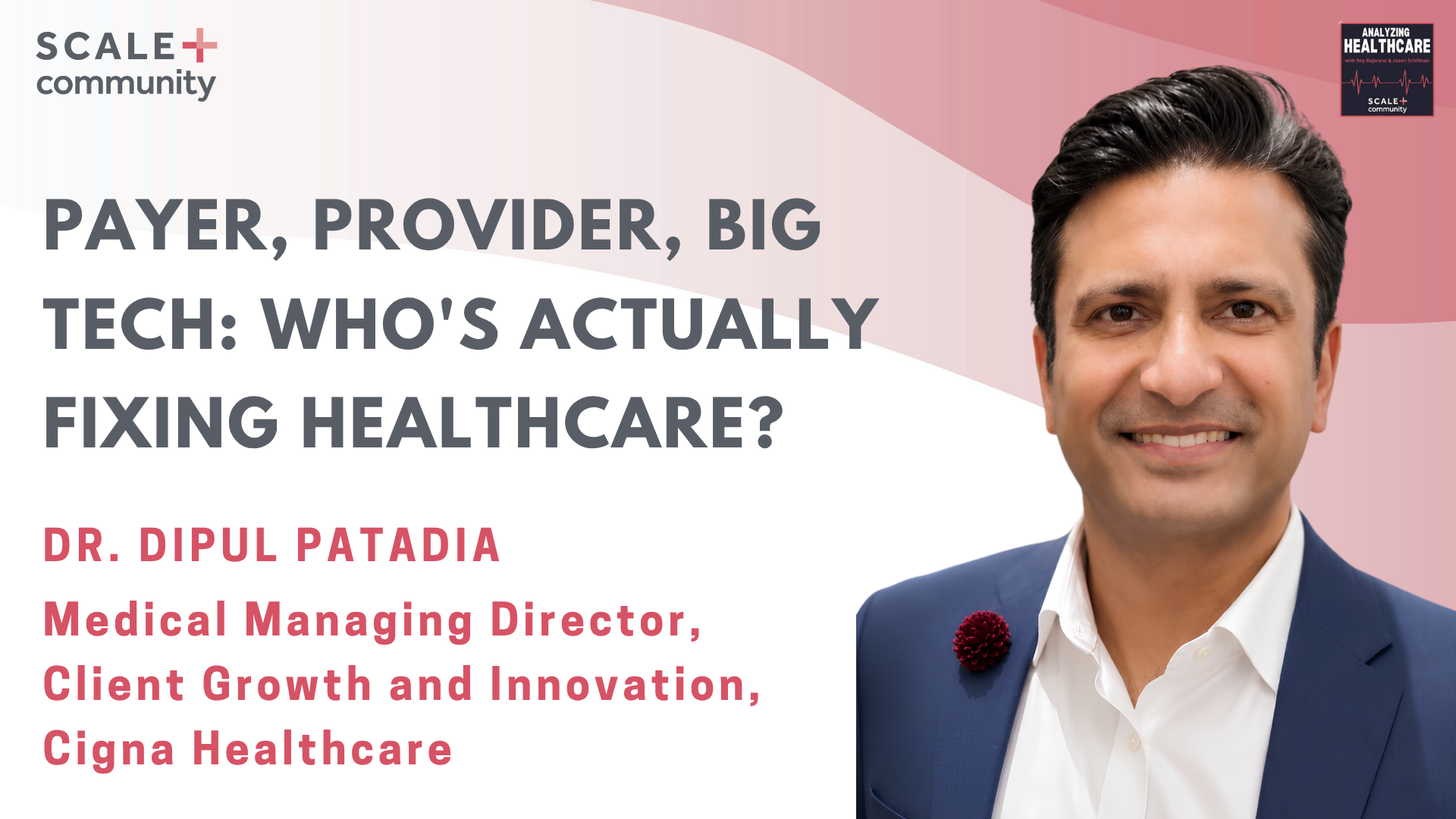
DescriptionU.S. healthcare transformation, AI adoption, value-based care, and payer-provider alignment take center stage as Dr. Dipul and Roy Bejarano explore what drives meaningful change.
In this episode of Analyzing Healthcare by SCALE Community, Roy Bejarano speaks with Dr. Dipul, Associate Chief Medical Officer at Cigna and former healthcare leader at Salesforce, Ascension, and Advocate. They explore payer-provider alignment, trust, AI adoption, workflow redesign, value-based care, clinical variation, and consumer healthcare. Dr. Dipul shares why meaningful healthcare transformation requires more than new technology; it demands aligned incentives, operational discipline, practical workflows, and focused execution to deliver sustainable value.
What You’ll Learn
✅ How payers, providers, and technology companies view healthcare differently
✅ Why incentive misalignment remains one of healthcare’s hardest problems
✅ Why trust is missing across major healthcare stakeholders
✅ How AI agents and CRM platforms fit into healthcare workflows
✅ Why workflow, change management, and incentives matter more than product elegance
✅ Why value-based care may not be dead, but still needs stronger execution
✅ How healthcare leaders can avoid chasing the “shiny penny” and focus on real problems
Key Timestamps
(01:42) Healthcare through payer, provider, and tech lenses
(05:28) Trust and incentive misalignment
(07:28) Healthcare innovation and high reliability
(10:04) Lessons from Salesforce and big tech
(12:48) The challenge of scaling AI agents
(14:32) Why workflow matters more than product elegance
(18:19) Is value-based care still alive?
(19:22) Provider-payer partnerships and navigation
(25:22) Alignment, loopholes, and commercial partnerships
(27:24) Why Dr. Dipul is still proud of U.S. healthcare
(31:44) What healthcare managers need to understand
(32:22) Consumer healthcare and avoiding the shiny-penny trap
Key Takeaways
💎 Healthcare’s biggest challenge may not be a lack of innovation, but misaligned incentives across payers, providers, technology companies, pharma, and regulators.
💎 Most healthcare organizations want better outcomes, but their operating models often push them toward different decisions.
💎 AI will only create value in healthcare when it fits real workflows, integrates data, and supports measurable execution.
💎 Value-based care still has promise, but the next phase depends on tighter payer-provider alignment, better access, navigation, and infrastructure.
💎 Product elegance alone will not transform healthcare; workflow assessment, change management, and incentive design are critical.
💎 U.S. healthcare remains a center of innovation, but affordability and sustainability will determine how far that innovation can scale.
💎 Healthcare leaders must start with the problem they need to solve, not the newest tool or trend.
Guest Bio
Dr. Dipul Patadia is Associate Chief Medical Officer at Cigna, where he helps advance clinical strategy, innovation, and client growth. He joined Cigna in 2025 after serving as Chief Health Officer at Salesforce, where he focused on applying technology to healthcare challenges. Previously, he held Chief Medical Officer roles at Ascension and Advocate Health, leading clinical initiatives and hospital operations. His work spans digital transformation, AI readiness, specialty care, quality improvement, and innovative value-based care strategies across payers, providers, and technology.
SEO Keywords
Dr. Dipul, Cigna, Roy Bejarano, SCALE Community, Analyzing Healthcare, payer provider alignment, healthcare incentives, healthcare innovation, AI in healthcare, agentic AI, Salesforce healthcare, value-based care, healthcare workflow, clinical variation, healthcare trust, consumer healthcare, healthcare management, payer strategy, health system transformation, healthcare technology, healthcare affordability