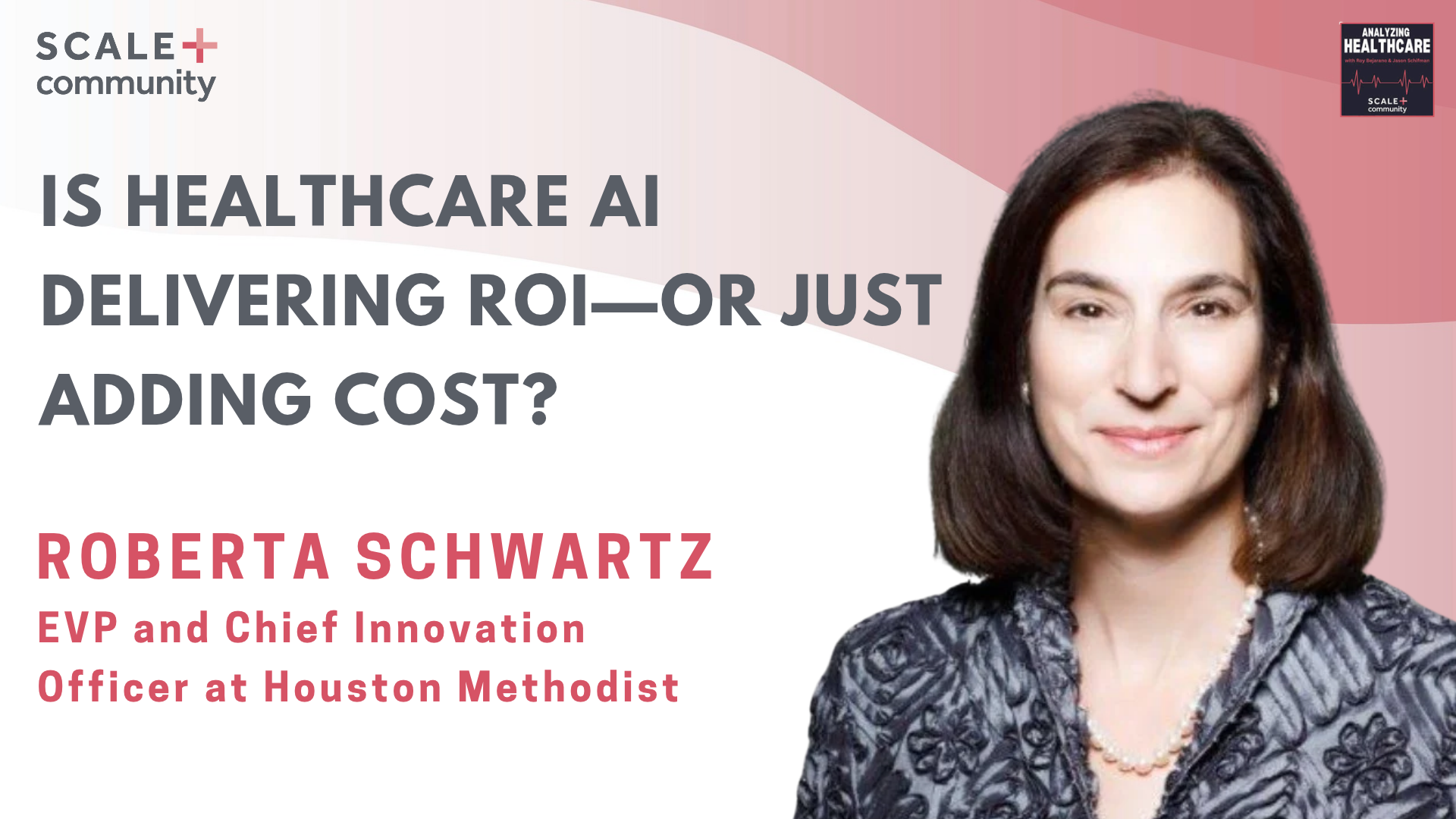
DescriptionHow Houston Methodist tests AI ROI, scales virtual care, builds smart hospitals, and challenges the cost of AI agents across nine hospitals, at scale.
Jason Schifman speaks with Roberta Schwartz, Houston Methodist’s EVP and Chief Innovation Officer, about disciplined healthcare innovation. She explains why the system prioritizes returns, three-year planning, scalable partnerships, and centralized virtual care over new tools. From smart rooms and remote monitoring to AI scheduling and clinical decision support, Roberta distinguishes operational savings from vendor promises. The discussion covers cautious AI-agent deployment, implementation challenges, technology consolidation, workflows, and how clinical quality and workforce sustainability define innovation success.
What You’ll Learn
✅ Why Houston Methodist plans innovation across three-year horizons
✅ How the system evaluates hard savings versus soft ROI claims
✅ Why AI agents may add expense without adding functionality
✅ How 2,500 to 2,600 connected rooms support virtual care and centralized teams
✅ Why its scheduling bot Zoe represents roughly 47 avoided hires
✅ What makes enterprise-wide scaling more valuable than narrow pilots
Key Timestamps
(01:08) Why Houston Methodist uses a partnership-led innovation model
(03:30) Smart spaces, virtual care, remote monitoring, and connected hospitals
(05:37) Care traffic control, smart charts, AI, and clinical intelligence
(07:55) Zoe scheduling bot and the caution around AI agents
(10:00) Why humanoid robots fail the scalability test
(13:54) Hard savings versus vendor-promised soft savings
(17:29) Why AI requires reimagining entire workflows
(19:43) Why Houston Methodist scales proven solutions, not alpha pilots
(22:03) Strategic technology partners and enterprise deployment
(26:08) Business ROI versus slower clinical transformation
(29:43) Measuring clinical outcomes, not just technology performance
(34:58) Build-versus-buy, vendor consolidation, and Epic capabilities
(40:39) Innovation as a tool for clinical excellence and workforce sustainability
(44:52) Standardizing care pathways and physician preference cards
Key Takeaways
💎 Innovation is a disciplined investment process, not a competition to adopt the latest technology.
💎 Hard ROI matters: technology that saves time without reducing or reallocating costs may simply add another layer of expense.
💎 Houston Methodist favors partners whose solutions can scale across its system, not just succeed in limited pilots.
💎 Connected rooms become valuable when their data enables new virtual workflows, centralized monitoring, and better staffing models.
💎 Clinical transformation is harder to measure than administrative automation and requires outcomes-based evaluation.
💎 Standardization and thoughtful centralization can improve efficiency while sustaining clinical quality.
💎 AI agents remain a selective investment until benefits justify their cost.
Guest Bio
Roberta Schwartz is Executive Vice President and Chief Innovation Officer at Houston Methodist, a nine-hospital health system. She leads a partnership-driven innovation approach spanning smart hospitals, virtual care, artificial intelligence, automation, technology adoption, and clinical transformation.
SEO Keywords
Roberta Schwartz, Houston Methodist, Jason Schifman, SCALE Community, Analyzing Healthcare, healthcare AI ROI, hospital innovation, AI agents, smart hospital, virtual nursing, virtual care, remote monitoring, care traffic control, AI scheduling, Epic, clinical AI, workflow redesign, hospital automation, vendor consolidation, healthcare technology ROI