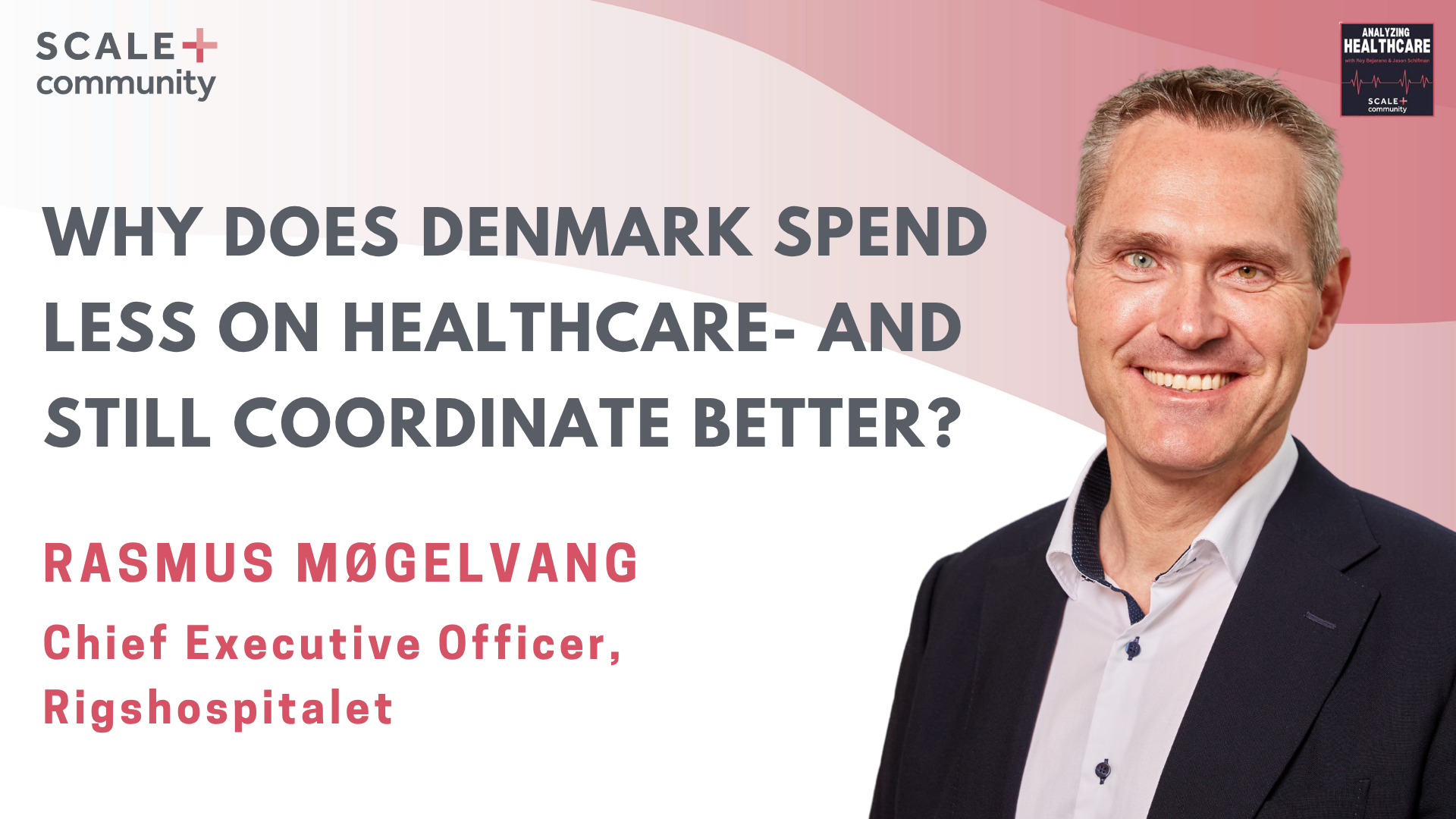
DescriptionDenmark’s healthcare model offers a different approach to coordination, efficiency, and patient-centered care.
In this episode of Analyzing Healthcare by SCALE Community, Roy Bejarano speaks with Rasmus Møgelvang, CEO of Rigshospitalet in Copenhagen, about centralized expertise, hospital-at-home care, national data infrastructure, workforce shortages, low-value care, fixed budgets, and public-private partnerships.
Rasmus shares what Denmark’s healthcare system can teach the U.S. about using resources more effectively, bringing care closer to patients, and building infrastructure for the future.
A timely conversation for healthcare executives, hospital leaders, policymakers, investors, and operators focused on health system design, digital infrastructure, workforce strategy, and value-based care.
What You’ll Learn
✅ Why Denmark centralized care expertise before decentralizing services
✅ How chemotherapy and oncology care can move safely into the home
✅ Why Denmark focuses on stopping low-value and harmful care
✅ How national data infrastructure supports coordination and remote care
✅ Why workforce shortages are forcing systems to rethink resource allocation
✅ How fixed budgets affect innovation funding
✅ Why public-private partnerships are critical to scaling new solutions
Key Timestamps
(00:14) Rigshospitalet and Denmark’s national hospital role
(02:02) Denmark vs. NHS and U.S. healthcare models
(05:05) Centralize knowledge, then decentralize care
(06:40) Cancer treatment at home
(09:26) Healthcare spending and waste
(11:00) Platform trials and low-value care
(13:25) Nordic data sharing
(14:30) Virtual Nordic University Hospital
(16:59) National patient data and interoperability
(18:40) Remote MRI, neurosurgery, and COVID response
(21:55) Global research and public systems
(23:59) Demographics and workforce shortage
(28:57) Limits of fixed-budget medicine
(32:13) Innovation and public-private partnerships
(32:49) Real partnerships with industry
Key Takeaways
💎 Denmark’s model shows the power of centralizing expertise and standards, then decentralizing care delivery closer to the patient.
💎 Hospital-at-home is not just a convenience strategy; it is a workforce, access, and capacity strategy.
💎 A value-based public system creates stronger incentives to identify and stop low-value or harmful care.
💎 National data infrastructure allows patient information to move across sites of care and support real-time coordination.
💎 Remote diagnostics and virtual specialty support can extend advanced care beyond the walls of major hospitals.
💎 Fixed annual budgets can support discipline, but they also make long-term innovation investment more challenging.
💎 Public-private partnerships help hospitals co-create scalable solutions rather than simply buying what already exists.
Guest Bio
Rasmus Møgelvang is Chief Executive at Rigshospitalet. He is a qualified physician and has previously been the Deputy Chief Executive of the hospital. He has also been the Centre Director of the Heart Centre at Rigshospitalet. Rasmus Møgelvang is also a member of the Danish government´s Life Science Council.
SEO Keywords
Rasmus Møgelvang, Rigshospitalet, Roy Bejarano, SCALE Community, Analyzing Healthcare, Denmark healthcare system, Nordic healthcare, single payer healthcare, hospital-at-home, healthcare centralization, healthcare decentralization, national patient data, interoperability, public-private partnerships, low-value care, workforce shortage, fixed budget healthcare, value-based care, healthcare innovation, health system design